Helping design and engineering professionals discover, evaluate and specify technologies and processes that shorten the design cycle and enable success.


Alert!
Digital Engineering ceased publication on July 1, 2026. This website remains available as an archive of engineering content.
For inquiries or information, please email [email protected].


May 2026 Special Focus: Artificial Intelligence in Design and Simulation
In this Special Focus Issue, learn about the latest developments in the integration of artificial intelligence into engineering workflows.

Design & Simulation Software Guide 2025
In this Special Issue, Digital Engineering presents its second annual guide to design and simulation software vendors.
This morning, AMD announced its intent to buy programmable chipmaker Xilinx in an all-stock transaction valued at $35 billion.
"The combination will create the industry’s leading high performance computing (HPC) company, significantly expanding the breadth of AMD’s product portfolio and customer set across diverse growth markets where Xilinx is an established leader," according to AMD.
AMD's product portfolio is primarily made up of CPUs and GPUs. With the acquisition of Xilinx, the company is posed to add a healthy collection FPGAs (field programmable gate arrays) and Adaptive SoCs (systems on chips) to its offerings.
This morning, AMD also reported strong 2020 Q3 earnings, which partly explains the company's shopping spree.
With the work station market facing stiff competition from mobile devices, tablets, and virtualization, leading chipmakers -- Intel, NVIDIA, and AMD -- are looking at the emerging HPC markets to replenish their lost grounds. One area of growth in HPC is the use of AI (artificial intelligence) or machine learning, especially in autonomous vehicle development. The amount of processing power such applications demands, translates to new sales for processor vendors such as Intel, NVIDIA, and AMD.
“Our acquisition of Xilinx marks the next leg in our journey to establish AMD as the industry’s high performance computing leader and partner of choice for the largest and most important technology companies in the world,” said AMD President and CEO Dr. Lisa Su.
AMD's rival NVIDIA has made acquisitions as part of its strategy to bolster HPC offerings. Last year, NVIDIA purchased Mellanox, an interconnect solutions provider, adding a critical component to its HPC business. Earlier this year, NVIDIA snatched up its long-time partner Arm, aiming to raise its profile in the AI market.
As a semiconductor maker, Xilinx serves markets unconnected gaming PCs and workstations, whcih have historically been the CPU and GPU makers' lifeblood.
“Our leading FPGAs, Adaptive SoCs, accelerator and SmartNIC (network interface card) solutions enable innovation from the cloud, to the edge and end devices," said Victor Peng, Xilinx president and CEO. "Joining together with AMD will help accelerate growth in our data center business and enable us to pursue a broader customer base across more markets.”
Such chips are a critical part of IoT-type solutions and connected field devices capable to transmitting data, betting on 5G connectivity to offer more capabilities. Bringing Xilinx onboard lets AMD secure a position in the markets for edge devices and data center components.
With similar foresights, CPU maker Intel acquired programmable field-device maker Altera five years ago. The transaction gave birth to the Intel Programmable Solutions Group.
"I'm not big on M&A (merger and acquisition). We don't do M&A for M&A's sake, but this is such a unique opportunity," said AMD's Lisa Su on a call with the investors this morning. "There actually is no better match for us in the industry than Xilinx."
"We have common visions not only in the data center business but also in the end-point and edge business," said Xilinx's Peng on the same call.
The two expressed an interest in combining thier respective software development energy to develop a programming environment that can rival NVIDIA's CUDA.


AMD, or Advanced Micro Devices, has driven innovation in high-performance computing, graphics and visualization technologies. They develop high-performance computing and visualization products to solve some of the world’s toughest and most…
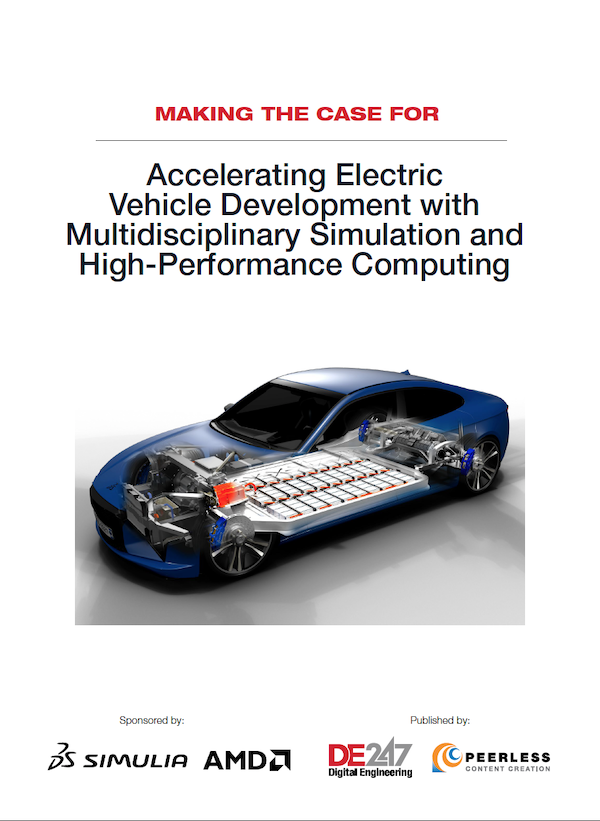
Accelerating Electric Vehicle Development with Multidisciplinary Simulation and High-Performance Computing
In this new Making the Case guide, learn how a unified approach to design and multidisciplinary simulation from Dassault Systèmes, combined with high-performance computing powered by AMD EPYC™ processors, can accelerate EV design.

Kenneth Wong is Digital Engineering's resident blogger and senior editor. Email him at [email protected] or share your thoughts or suggestions at digitaleng.news/facebook.
Follow DE






About Us · Contact Us · Editorial Team · Advertising · Privacy Policy · Subscriber Services · © 2026 Digital Engineering 24/7 · Peerless Media