Helping design and engineering professionals discover, evaluate and specify technologies and processes that shorten the design cycle and enable success.


Alert!
Digital Engineering ceased publication on July 1, 2026. This website remains available as an archive of engineering content.
For inquiries or information, please email [email protected].
Sponsored
Dear DE reader,
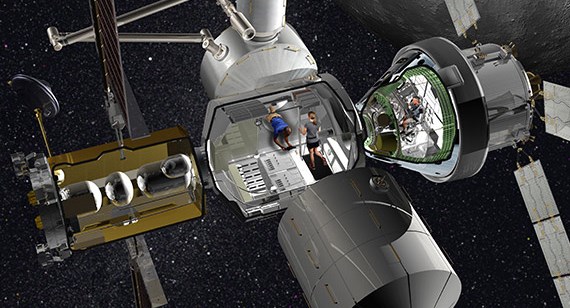
If you’ve ever gone down the rabbit hole of online videos dedicated to tiny houses, you’ll understand the challenges faced by the design engineers involved with NASA’s Gateway concept. Well, at least some of the challenges. I don’t expect astronauts orbiting the moon to bring their pet St. Bernard and twin children along for the ride like some tiny house builders do, but I digress. Aerospace giant Lockheed Martin has been tasked with designing parts of the infrastructure for the Gateway, a small spaceship that will be in orbit around the moon.
The idea is for the Gateway to serve as a temporary home and office for astronauts, allowing them to conduct research on the Earth, sun and moon. It’s part of the ramp up to send humans to Mars. According to NASA, Gateway will include living quarters, laboratories and docking ports so astronauts can come and go, spending about three months living and working there at a time. If you’re thinking that will require some pretty sophisticated design and engineering, you’re right.
Lockheed Martin tapped Protolabs for rapidly fabricating sheet metal components that it’s using to build a full-size prototype of the tiny house portion of the spaceship, which it calls the Habitat Ground Test Article (HGTA). The HGTA is being constructed in Florida, and once completed, will be used to ensure the astronauts will have a good experience and everything they need on the space-bound version.
Protolabs has a cool post explaining all the details of its work with Lockheed Martin on the HGTA. The high points are that Lockheed Martin wanted to use sheet metal for some of the HGTA’s secondary infrastructure that will hold both scientific experiments and the payloads needed to maintain the habitat. Sheet metal ticked all the boxes for weight, strength, longevity and safety.
As in any application intended to fly, keeping weight to a minimum was important for fuel savings—but that needed to be balanced with strength requirements. Of course, safety in a tiny house that will be 250,000 miles from the nearest hospital was paramount. The longevity aspect took special consideration, as the Gateway is expected to last for a generation and needs to be able to expand to meet future needs. For that reason, the parts Protolabs supplied were designed to be modular so they could be modified as needed.
The Protolabs parts are installed in the HGTA and a testing phase has begun. Check out the Protolabs post for the full story of how rapid manufacturing fulfilled Lockheed Martin’s and NASA’s needs for this next-generation space mission—and maybe get a few ideas for designing your tiny house.
Thanks for reading DE.
—The editors


DE's editors contribute news and new product announcements to Digital Engineering. Press releases may be sent to them via [email protected].
Follow DE
Join over 90,000 engineering professionals who get fresh engineering news as soon as it is published.






About Us · Contact Us · Editorial Team · Advertising · Privacy Policy · Subscriber Services · © 2026 Digital Engineering 24/7 · Peerless Media