Helping design and engineering professionals discover, evaluate and specify technologies and processes that shorten the design cycle and enable success.



Digital Engineering April 2026
In the latest issue of Digital Engineering, we take a look at the latest innovations in design for additive manufacturing, including the use of natural language inputs, social media cosplayers, and AI integration. The issue also includes a feature…

January Special Focus Issue: Design for Additive
In this Special Focus Issue of Digital Engineering, learn about the latest advancements in design for additive manufacturing, including new software tools, additive in automotive, custom medical devices, and more.
Before the winter of 2019, few analysts and industry leaders imagined a pandemic would upend the worldwide manufacturing operations and revenue streams. Not that they didn’t believe such an event could occur, but they just considered it highly unlikely. Consequently, the industry didn’t think to develop mitigation. But by early 2020, the virus had spread beyond Asia, forcing people and businesses around the world to retreat indoors.
Nearly a year and a half later, as the world slowly emerges from lockdown, businesses are also rethinking how they operate. A contingency plan for a pandemic-like event is now on nearly everyone’s mind. DE spoke to design and engineering technology providers to understand any learned lessons and their preparedness for mega disruptors.
Although the pandemic slowed down people’s physical movements, it also accelerated the digitization process, notes Cliff Rice, global industry consultant for Electric Vehicle & Battery Manufacturing at Rockwell Automation.
“The industry had been moving towards digitization, and the utilization of digital twins was becoming more prominent. The effects of COVID-19 amplified the benefits of these technologies and fast-tracked their adoption,” Rice says.
For the digital twin projects, the pandemic cuts both ways. The pandemic gave businesses a sense of urgency to adopt and use digital replicas.
“But getting all the key stakeholders on the same page to develop, adopt and roll out a digitization strategy requires collaborative meetings. Ironically, those are best done face to face, especially with a workforce that may be new to virtual meetings and remote collaboration,” Rice explains.
In the pandemic’s early days, businesses scrambled to cope with the requirements of social distancing and mandatory lockdowns. The mad rush exposed many digital tools that were ill-prepared to facilitate the transition at such a breakneck pace, on such a massive scale.
“The physical closure of many engineering facilities forced millions of engineers to log into systems that were not designed to work remotely,” says John McEleney, co-founder of the cloud-based CAD vendor Onshape, now part of PTC.
“Poor performance, login code problems and file download/upload issues caused hundreds of thousands of users to lift their heads and realize that there’s got to be a better way,” he says.
Founded by several former SolidWorks executives, Onshape built a CAD product that runs in the cloud from a standard browser. This departed from the standard CAD software, which was designed to run on personal workstations.
Without access to their office in the pandemic, many engineers were forced to make do with home computers that were underequipped to run CAD software. The experience may encourage CAD users to explore more cloud-hosted, remote-access products.
“Some key players in manufacturing were caught flat-footed in long-entrenched ways of working,” says Srinath Jonnalagadda, vice president of Industry Strategy, Design & Manufacturing, Autodesk. “The pandemic quickly showed many that they were unprepared for shocks to the system and needed new tools, which resulted in a dramatic turn toward adoption of cloud technologies.”
COVID-19’s impact on software development is negligible, as most development teams are accustomed to working with chunks of code, testing the build and debugging them without being in the same room. In some cases, the pandemic actually boosted productivity.
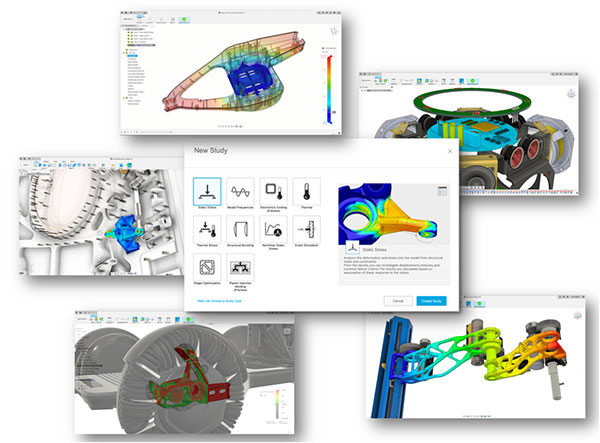
At Autodesk University 2021 virtual, Autodesk released role-specific Fusion Extensions for Autodesk Fusion 360 users. Image courtesy of Autodesk.
“NX is developed by a global development team with R&D centers around the world, so we are used to remote development environments,” says Paul Brown, senior marketing director at Siemens Digital Industries Software. “Obviously, there was an increase in use of systems like TEAMS for conferencing to replace face-to-face project reviews, but we continued to develop and innovate throughout the shutdown.”
“Even before the pandemic, Autodesk was focused on the cloud to empower a distributed workforce,” says Jonnalagadda. “Fusion 360 R&D teams are in at least 10 locations around the globe, so [they] were already accustomed to working across time zones, languages and cultures. They frankly didn’t miss a beat, and in some cases, due to reduced travel time, meetings and interruptions, we actually saw productivity increase.”
Many CAD vendors offer free or less expensive versions of their flagship products as part of their strategy to build brand familiarity among the next-generation engineers. With instructions moving to remote classrooms during the pandemic, the demand for education licenses climbed.
“Pre-pandemic, Onshape was making good progress in the education space and the headwinds of COVID-19 quickly turned to tailwinds. Education users grew over 10 times in less than 18 months to over 1.4 million users,” says McEleney. “Once people experience Onshape and the fundamental way that we allow you to rethink and redesign your workflow, they will not go back to installed software.”
The shutdown may also have changed how engineering teams access their professional software, which could have implications on vendors’ licensing policies in the future.
“Onshape is growing 10 times faster than the CAD market and we have over 2 million users,” says McEleney.
“Siemens has included the concept of ‘take-home’ licensing in our products for years and many customers simply took advantage of this approach, having a user log in and start NX and then be able to take that license away from the central pool meant that there was no disruption,” says Brown. “Additionally, some users looked at using streamed virtual delivery agent services like Citrix. Once again, NX has been certified and used by customers with that configuration so this allowed them to expand that environment.”
Brown and his sales associates also had to adapt without the ability to demonstrate the software on-premises.
“Traditionally our Early Access Program (Beta) was a mix of customer site activity and having customers visit our development facilities for a consolidated block of testing,” he explains. “Obviously we could not run face-to-face activities, so we were ramping up our remote access to software, using daily drop-in calls for customers to discuss anything they have concerns or issues with. We made it as easy as possible for people to contact our subject matter experts.”
Historically, Early Access Program participants were a small pool. But “with the need to travel removed, we saw a massive increase in participation from around the world,” Brown notes.
In late October, analyst firm Altimeter and Autodesk released a report titled, “Understanding Convergence: The Next Wave of Digital Transformation.”
The report’s author Charlene Li, senior fellow at Altimeter, noted, “Previously innovative practices such as virtual communications, personalized digital engagement, immersive modeling, rapid prototyping and efficient collaboration are now mainstream due to an accelerated need brought on by the COVID-19 pandemic.”
Jonnalagadda says, “During the last 19 months, Autodesk has put in place a new flexible pricing model, accelerated the release of software extensions for Fusion 360, deepened several of our technology partnerships and increased our investment in cloud technologies such as Upchain’s product lifecycle management solution.”
In January 2019, Rockwell Automation acquired Emulate3D, which develops software for industrial automation system simulation and emulation. The software eventually became part of Rockwell Automation’s digital design portfolio, targeting the automotive, logistics and material handling sectors.
The company now sells it as part of FactoryTalk DesignSuite. It also became a critical component of the customers’ digital twin strategy during the shutdown.
“Customers use Emulate3D for virtual design and code reviews. Other customers are leveraging the FactoryTalk Innovation Suite for its augmented reality capabilities,” says Rice. “They collaborate globally using tablets and wearable devices to see the digital world and annotate on top of the real world. Both use cases are being driven by the need to remove unnecessary travel while supporting global operations.”
Increased reliance on digital twins redefines the role of human engineers. Increasingly, human experts retreat from the hazard frontlines and repetitive tasks. Instead, they now oversee operations from the digital control panels.
“Now the most experienced paint shop engineer can put eyes and ears on ovens all around the world. The best production planning engineer can review digital dashboards and line layouts, to run experiments and optimize production anywhere. The sharpest controls engineers can review code and squeeze each millisecond of tact time out of the system from their home office,” says Rice.
In certain tasks, Rockwell Automation is also leveraging machine learning (ML) to automate routine monitoring tasks.
“We are leveraging ML algorithms to make on-the-fly adjustments to the application code in a programmable logic controller. Platforms like FactoryTalk Analytics and our edge computing hardware make this possible,” says Rice.
The changes that happened during the pandemic are irreversible, according to the industry experts. Though available vaccines and relaxing travel restrictions suggest a return to the office and customer site visits, engineering and manufacturing appear to be heading to a new normal, where digital twins and broadband connections are an integral part of productivity.
“Going forward we see a hybrid model evolving, we will reintroduce face-to-face meetings, but we will continue with the expanded network of Early Access for our customers with virtual support,” says Brown.
Similarly, Jonnalagadda says, “We expect a working model in the future that is truly hybrid, with work done remotely and in the office. We’ve learned that our teams can be highly productive in both environments.”
The shift to the cloud and changing platforms puts certain IP-sensitive industries in a quandary, as established norms and regulations discourage the use of public clouds. “The irony of cloud-based solutions is that they are far more secure than the ‘idealized secure’ installed-base system. Ironic, because traditional thinking suggests that if I can see the workstation or server, then it must be secure. The reality is the opposite,” notes McEleney.


Autodesk is a world leader in 3D design, engineering, and entertainment software. They produce software for the architecture, engineering, construction, manufacturing, media, and entertainment industries.

Kenneth Wong is Digital Engineering's resident blogger and senior editor. Email him at [email protected] or share your thoughts or suggestions at digitaleng.news/facebook.
Follow DE
Join over 90,000 engineering professionals who get fresh engineering news as soon as it is published.






About Us · Contact Us · Editorial Team · Advertising · Privacy Policy · Subscriber Services · © 2026 Digital Engineering 24/7 · Peerless Media