Helping design and engineering professionals discover, evaluate and specify technologies and processes that shorten the design cycle and enable success.


Alert!
Digital Engineering ceased publication on July 1, 2026. This website remains available as an archive of engineering content.
For inquiries or information, please email [email protected].

Design & Simulation Software Guide 2025
In this Special Issue, Digital Engineering presents its second annual guide to design and simulation software vendors.

Design & Simulation Software Guide
In this Special Issue, Digital Engineering presents its inaugural guide to design and simulation software vendors, including listings for CAD, CAM, simulation, generative design, PLM, rendering and visualization, design for additive manufacturing,…
As I write this article, I and my co-editors of Digital Engineering, located in different states of the U.S., are also under lockdown. We are blessed with reliable internet connections, well-established remote-working protocols, well-stocked pantries and the support of our loved ones to keep publishing news.
The widespread stay-at-home orders, so far, have not prevented us from bringing you inspiring stories about how engineers, academia and manufacturing firms are fighting back. If anything, we now have more news to share with you than ever before.
Some construction and manufacturing activities have halted. Some supply chains are groaning under the pressure of unanticipated demands. Can engineers continue to collaborate and keep projects moving forward during the crisis? Even if our physical movements are restricted, can we remain productive in pixels and bytes?
The answer is a resounding “Yes, we can.” But this routine also points to a new normal.
On April 15, Business Insider reported that “more than a third of the planet’s population is under some form of restriction” (“A third of the global population is on coronavirus lockdown”).
Jonathan Scott, chief architect at Razorleaf, a product lifecycle management (PLM) consulting firm, noticed a change in how he and his colleagues connect remotely during the lockdown.
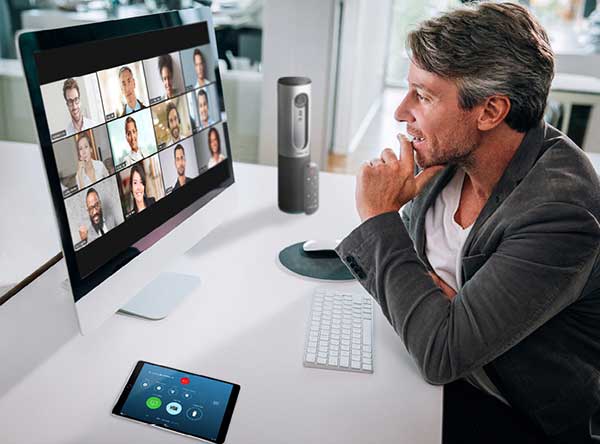
“People are now more willing to chat on video,” says Scott. “We’ve been using remote meeting for a long time, but now that people are staying home, I’ve noticed that people are using video chat more.”
For Razorleaf, with travel restrictions that make client site visits impossible, video conferencing plays another important role.
“In a lot of the work we do, like one-on-one or one-to-many interviews, we like to assess people’s reaction. Being able to read someone’s expression is very helpful,” says Scott.
Some U.S. cities, like San Francisco and Chicago, began issuing shelter-in-place orders around mid-March. By April 2, Reuters reported that “Zoom pulls in more than 200 million daily video users during worldwide lockdowns.”
With use cases from public schools and universities, exercise classes, public relations teams and engineering teams—all types of new users are logging on to the video conference application Zoom to continue their teaching, learning, outreach and collaboration the best they can during times of restricted movement. This has exposed Zoom’s security flaws, forcing the company to publicly address them and swiftly fix them. (“Here’s What Zoom Is Doing to Make Its Service Safer,” Forbes, April 10, 2020).
“Some companies have had remote-working infrastructure in place for a while, but they clearly didn’t use it much,” observes Scott. “So, when a whole of people try to connect from home, they suddenly found out some popular conferencing apps conflict with their VPN settings.”
It’s a cautionary tale for companies now scrambling to move their workloads online. Certain conflicts that used to be isolated cases (such as a remote conferencing app’s compatibility with the PLM system or employees’ VPN accessibility from home) may crop up in larger numbers due to increased users going online, overwhelming the IT support staff, who are themselves working in limited capacity due to the lockdown.
Razorleaf had previously agreed to deliver a day-long in-person class, but the lockdown threatened to cancel the event.
“The customer asked us, ‘Well, will you be willing to do it remotely?’ We said, ‘Sure,’” recalls Scott. “But you just can’t do an eight-hour virtual training, so we learned to reduce it to four to six hours, with lots of long breaks in-between.”
Scott believes the crisis may make some customers realize certain consulting and training tasks can, in fact, be more efficiently delivered remotely.
“After this, people who used to say ‘No, you gotta come onsite to do this’ may be more willing to accept remote work,” he reasons.
On March 19, as select cities began their lockdowns, Graebert, the developer of ARES drawing and drafting software, announced a short-term opportunity for users to try its browser-based CAD-editor ARES Kudo free of charge through the end of May 2020.

To facilitate online work, ARES began offering free licenses of its ARES Kudos DWG editing software during the COVID-19 crisis. Image courtesy of ARES.
“There will be obviously a cost for Graebert to run and scale up the infrastructure accordingly, but we are prepared for it. We feel it is our duty to encourage people to stay at home and help the CAD community to maintain their activity,” says Wilfried Graebert, CEO of Graebert.
The cost to Graebert comes from boosting the backend Amazon Web Services infrastructure to support the anticipated spikes in users. One person taking advantage of the giveaway is Kuntay Kunt, manager of Form Metal Sanayi, a steel parts and steel construction manufacturer.
“We are not under lockdown—yet. We divide employees into three shifts to enable social distancing. So my engineers and technical employees are divided into three groups. They have common hours to pass the work between groups,” Kunt explains.
Kunt and his colleagues continue their operations with a mixture of Google Drive, Microsoft One Drive and ARES cloud-based software.
“When we change the thickness of some elements in a DWG with a lot of objects, like construction projects, we divide objects according to technical terms—trusses, columns and so on—for engineers to work with specific revisions. Then we merge the work in the cloud. When the revisions are done, everybody can access the master file and revision files from [the] team’s shared folders,” he says.
At my request, Kunt sent his internet connection speed verification. It was 14Mbps download, 8Mbps upload. By contrast, my home connection from Xfinity is 375Mbps download, 17Mbps upload. In that respect, Kunt’s connection is modest, but it gets the job done, he says.
“We are still running and fully operational. However, there are restrictions,” he admits. “We cannot go to our customer to get information about a quotation, so we cannot deliver a fully cost-estimated designed solution for a specific project. Orders are delivered by mail and communication is going on via phone and WhatsApp.”
At some point, the digital design needs to be made physical. This step is currently unpredictable due to the lockdowns that keep many production facilities shuttered.
For the designers at the Kansas-based infrastructure firm HNTB, their workstations with NVIDIA Quadro RTX graphics processing units (GPUs) are indispensable. The firm’s specialty is visualization in architecture, construction and transportation. They rely on the hardware to produce high-quality renderings.

The project typically begins with aerial imagery from the provider NearMap. The data is then imported into Autodesk 3ds Max software for analysis and design development. With the employees working from home, HNTB visualization artists now use NVIDIA’s remote GPU access software to harness the horsepower of the GPUs from their regular home computers. Recently, NVIDIA made vGPU (virtual GPU) licenses free for up to 500 users for 90 days in response to the widening lockdowns.
“Our team has experienced almost no downtime, and we didn’t need to scale back our current workload,” says Austin Reed, 3D visualization team lead and supervisor at HNTB. “This allows our team to work from home during these early days of COVID-19 just like we were in the office.”
VMware, a virtual desktop infrastructure (VDI) solutions provider, has partnered with GPU maker NVIDIA to deliver remotely accessible virtual machines with GPU acceleration. These offerings specifically target users who need intense graphics, such as CAD engineers, scientists, architects and manufacturing professionals.
Some experts think the crisis has made many realize the powerful role of infrastructure as a service, software as a service and many other cloud-hosted products. This puts a new burden on engineering and manufacturing software vendors who have historically catered to desktop users, notes Vincent Frerebeau, director of Worldwide Cloud at Dassault Systèmes.
“[The crisis] is accelerating our own need to develop web-based versions of our software,” he remarks. “Computers people use at home don’t have the same capacity as certified workstations, so people cannot use the same tools. Customers are now looking for light versions of our software. We need to offer solutions much more accessible from the internet, with light installation or no installation at all. For our key brands, like SolidWorks and CATIA, we have full web-based versions available.”
Remote access to data center computing power is important for many because powerful CAD programs require certified GPUs and CPUs, with large memory and storage footprints—a configuration typically not found on home PCs.
Companies might set up VDIs to enable remote access to the workstations located in shuttered offices, “but these kinds of solutions cannot easily be brought online during a crisis,” warns Frerebeau.
Now, a month into the nationwide lockdowns, different states have begun contemplating cautious and gradual return to normal life. But whatever we return to won’t be exactly like before.
“What we don’t know about this crisis is how it will accelerate the transformation of our customers,” notes Frerebeau. “For sure, there will be [a] consolidation of actors. Some might stop working with certain suppliers. Some smaller ones might disappear. We may see a vertical consolidation of suppliers and supply chain networks. Even some big companies will have difficulties restarting.”
The mandatory work-from-home period allows remote software and web-based vendors to shine. While engineering innovation continues in one form or another under lockdown, great uncertainties loom large. Many public companies have had to revise their earnings outlooks for 2021 due to the crisis, signaling the bumpy road ahead.
Note: For more on collaboration during the COVID-19 crisis, read “COVID-19 Spike Puts Remote Collaboration to the Test” by Beth Stackpole, April 2020, here.


Dassault Systèmes, the 3DEXPERIENCE Company, is a catalyst for human progress. We provide business and people with collaborative virtual environments to imagine sustainable innovations. The 3DEXPERIENCE platform enables companies to create and…

Electrum utilizes the 3DEXPERIENCE platform on the cloud to develop their new electric motorcycle
Electrum, a new brand of electric motorcycles, utilizes the 3DEXPERIENCE platform. Their mission is to support Indonesia’s shift to low-carbon, sustainable transport and to ultimately help the country’s government achieve its vision of net zero carbon emissions by 2060.

Kenneth Wong is Digital Engineering's resident blogger and senior editor. Email him at [email protected] or share your thoughts or suggestions at digitaleng.news/facebook.
Follow DE






About Us · Contact Us · Editorial Team · Advertising · Privacy Policy · Subscriber Services · © 2026 Digital Engineering 24/7 · Peerless Media