Helping design and engineering professionals discover, evaluate and specify technologies and processes that shorten the design cycle and enable success.



Design & Simulation Software Guide 2025
In this Special Issue, Digital Engineering presents its second annual guide to design and simulation software vendors.

Special Focus Issue: Artificial Intelligence in Simulation
In this Special Focus Issue of Digital Engineering, we look at the latest trends in integrating AI and machine learning with design and simulation tools. The issue includes features on synthetic data, open-source AI for modeling, AI-powered…
As supply chains come to a grinding halt, and hospitals are facing shortage of personal protective equipment (PPE), 3D printer owners, from professional service providers to individual hobbyists, rally to fill the void.
3D printer maker Stratasys launched a campaign to organize its partners to produce face shields. Face shields protect doctors and nurses from droplets when treating patients with COVID-19. They usually include two parts: the frame to mount it on the head, and the clear plastic sheet.
If you have the right STL file, you can print the frames, then mount a store-bought or laser-cut plastic sheet to create a homemade face shield.
The Columbus, Ohio-based CAMS (Columbus Advanced Manufacturing Systems) is also making face shields and donating them to healthcare workers.
Techie and YouTuber Joel Telling was asked by a friend, who is an emergency room nurse, to make some face shields because her hospital is running low on them. Joel uses an open-source-design printer from Prusa Research and another from Raise3D. He can churn out about 15 visor frames a day, and he has donated a few hundred to local hospitals so far.
Other 3D printer makers, like 3D Systems, and industry groups like America Makes also have similar projects in place. If you have a printer and want to help, check out the links below.
3D Systems: http://www.3dsystems.com/covid-19-response
Carbon 3D: http://www.carbon3d.com/covid19
Fictiv: www.fictiv.com/covid-19-face-shields
Stratasys: https://www.stratasys.com/covid-19
Syracuse University: www.syracuse.edu/stories/3d-print-response-covid-19/
MIT E-Vent: http://e-vent.mit.edu
Massivit3D: www.massivit3d.com
HP: http://enable.hp.com/us-en-3dprint-COVID-19-containment-applications
Tech firms capable of producing PPE are now accepting direct orders from hospitals. This includes Fictiv, an on-demand manufacturing service provider, and Carbon, a 3D printer developer.
3D printer maker Carbon is partnering with Adidas to print face shield frames, using its digital light synthesis technology. The company uses the same material used in the 4D-printed footwear cocreated by Carbon and Adidas. Carbon is now producing 18,000 PPE face shields per week, according to the company.
Carbon plans to make the printable 3D file open-source so anybody with a compatible printer can print it.
Carbon is also producing testing swabs to increase the volume of tests possible to identify people with Coronavirus. The company says it can scale up to a million swabs per week.
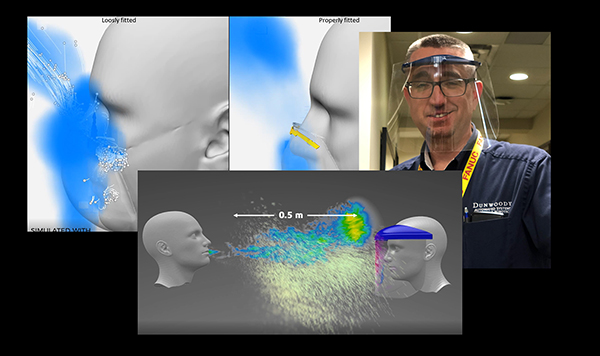
Some simulation software vendors have been using their technology to better understand what happens when you sneeze, or if you fail to maintain the recommended social distancing protocols.
Dassault Systemes published a sneeze simulation, done with SIMULIA PowerFLOW. The simulations are based on 1st principle physics and the animation demonstrates how sneezing transports droplets from one individual to another; and how the shield provides a certain level of protection during the event.
ANSYS has also created a number of video clips, showing how a face mask with proper nose clip prevents harmful droplets or particles from coming in contact with the user.
In another clip, the simulation compares side-by-side jogging to following behind another jogger. The research is done by Professor Bert Blocken and Fabio Malizia at TUe (Eindhoven University of Technology) & KU Leuven University. Previously they use similar methods to analyze the effects of different riding positions in a peloton.


Dassault Systèmes, the 3DEXPERIENCE Company, is a catalyst for human progress. We provide business and people with collaborative virtual environments to imagine sustainable innovations. The 3DEXPERIENCE platform enables companies to create and…

Electrum utilizes the 3DEXPERIENCE platform on the cloud to develop their new electric motorcycle
Electrum, a new brand of electric motorcycles, utilizes the 3DEXPERIENCE platform. Their mission is to support Indonesia’s shift to low-carbon, sustainable transport and to ultimately help the country’s government achieve its vision of net zero carbon emissions by 2060.

Kenneth Wong is Digital Engineering's resident blogger and senior editor. Email him at [email protected] or share your thoughts or suggestions at digitaleng.news/facebook.
Follow DE
Join over 90,000 engineering professionals who get fresh engineering news as soon as it is published.






About Us · Contact Us · Editorial Team · Advertising · Privacy Policy · Subscriber Services · © 2026 Digital Engineering 24/7 · Peerless Media