Helping design and engineering professionals discover, evaluate and specify technologies and processes that shorten the design cycle and enable success.


Alert!
Digital Engineering ceased publication on July 1, 2026. This website remains available as an archive of engineering content.
For inquiries or information, please email [email protected].

Design & Simulation Software Guide 2025
In this Special Issue, Digital Engineering presents its second annual guide to design and simulation software vendors.

Design & Simulation Software Guide
In this Special Issue, Digital Engineering presents its inaugural guide to design and simulation software vendors, including listings for CAD, CAM, simulation, generative design, PLM, rendering and visualization, design for additive manufacturing,…
This week, Altair launched Altair One, an online portal with a catalog of its software titles and on-demand computing services.
Altair One can be remotely accessed using any devices, from PCs and laptops to mobile devices, the company points out. The portal features cloud-hosted versions of Altair's well-known software titles, such as HyperWorks, HyperMesh, and OptiStruct. It also houses partner products, such as FEMAT, CADdoctor, and AlphaCell.
Two offerings exclusive to Altair One are:
The company points out that with Altair One, you can:
Users pay for access to products using Altair Units, the company's token-based payment system.
The Altair One model is similar the Autodesk model, which lets you access on-demand computing right from inside an application. This could become a standard practice with most simulation software.
Remote collaboration is already a standard practice, even before the pandemic shutdown forced engineers to retreat indoors. To facilitate people working with different software but using the same 3D data, NVIDIA developed NVIDIA Omniverse, a virtual collaboration space. For much of the past year it was in Beta, accessible to a few lighthouse customers, but as of April, it’s available for enterprise licensing.
Omniverse uses USD (Universal Scene Description language) developed by Pixar for data exchange. It includes GPU-accelerated graphics, NVIDIA’s Physx physics engine for simulation, and machine learning tools. It connects with 3d Studio Max, Maya, SketchUp, Unreal game engine, Rhino, and Revit, among others.
The Beta product is still available for individuals to download and try out. For more, read the report on NVIDIA GTC 2021 here.
If you want to try out riding an autonomous vehicle in the fog, Ansys has the software to let you do this virtually. The new product is for autonomous car developers. It's made possible by Ansys’s partnership with FLIR.
The two companies announced, "FLIR will integrate a fully physics-based thermal sensor into Ansys’s leading-edge driving simulator to model, test, and validate thermal camera designs within an ultra-realistic virtual world. The new solution will reduce original equipment manufacturers’ (OEM) development time by optimizing thermal camera placement for use with tools such as automatic emergency braking (AEB), pedestrian detection, and within future AVs."
You can see the world through thermal cameras, or see it as CT scans. As CT Scan data, you might be able to uncover flaws and imperfections in your parts that are invisible to the naked eyes. For that, you could turn to Volume Graphics’s CT Scan software and data analysis tools. Volume Graphics is part of Hexagon, specializing in sensor and manufacturing software, among others.
Version 3.5 of the software, released this month, features enhanced mesh compensation, a reworked manufacturing geometry correction module, and porosity and inclusion analysis function for casting.


Altair transforms design and decision making by applying simulation, machine learning, and optimization throughout product lifecycles. Altair offers software in five categories related to Computer Aided Engineering (CAE) and High Performance…
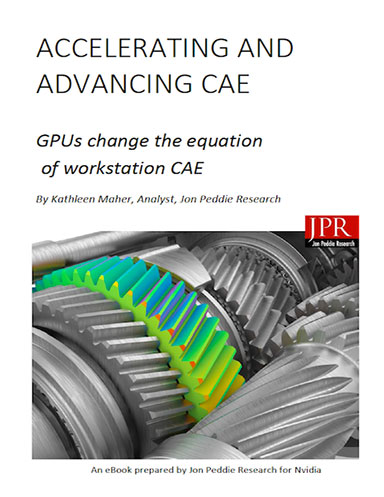
Accelerating and Advancing CAE
GPUs are changing the nature of engineering simulation, according to a new ebook from Jon Peddie Research (JPR). It explains how GPU acceleration is improving CAE workflows.

Kenneth Wong is Digital Engineering's resident blogger and senior editor. Email him at [email protected] or share your thoughts or suggestions at digitaleng.news/facebook.
Follow DE






About Us · Contact Us · Editorial Team · Advertising · Privacy Policy · Subscriber Services · © 2026 Digital Engineering 24/7 · Peerless Media